

In September 2024, Mario Draghi’s report on European competitiveness listed the reasons why firms in Europe “stay small” and neglect the Single Market. One of them is “the high cost of complying with regulations that apply once companies reach a particular size”. The same report counts “around 100 tech-focused laws” in the EU. For a firm that wants to scale across the digital single market, the two findings meet in one question. Which of those laws treat it as small?
I answered it empirically. I coded every provision in the 34 binding instruments of the EU digital rulebook that makes an obligation depend on the size of a firm, 290 rules in all. The rulebook cares a great deal about small firms, far more than it did a decade ago. It has never agreed on who they are.
Blaise Pascal, the seventeenth-century French mathematician, gave a test for when a word can safely go undefined. In his essay on the geometric mind, he accepted that a word such as “time” needs no definition, because everyone who uses it points to the same thing, even if they disagree about what time ultimately is. “Small” could go undefined in EU law on the same condition, if every law pointed to the same firms. The data show that they do not.
Small, by whose definition
The EU has defined small firms officially since 1996, and in its current form since 2003, in Commission Recommendation 2003/361/EC. It sets ceilings of 10, 50 and 250 persons, each with a turnover cap, and it says how to count. A firm is measured together with the enterprises linked to it, and it changes category only after two consecutive accounting periods above a ceiling.
Seventeen of the 34 instruments refer to that Recommendation, five of them only in a recital. Twenty use a size term somewhere in their operative provisions without defining it, among them the AI Act, which has 33 size-based rules and defines neither “SME” nor “start-up”. The GDPR counts heads and nothing else. DORA writes its own definitions, and they leave a gap. A financial entity with 20 staff and EUR 1.5 million of turnover and balance sheet is neither micro nor small, so DORA treats it as medium-sized (see Exhibit 3).
What small firms get
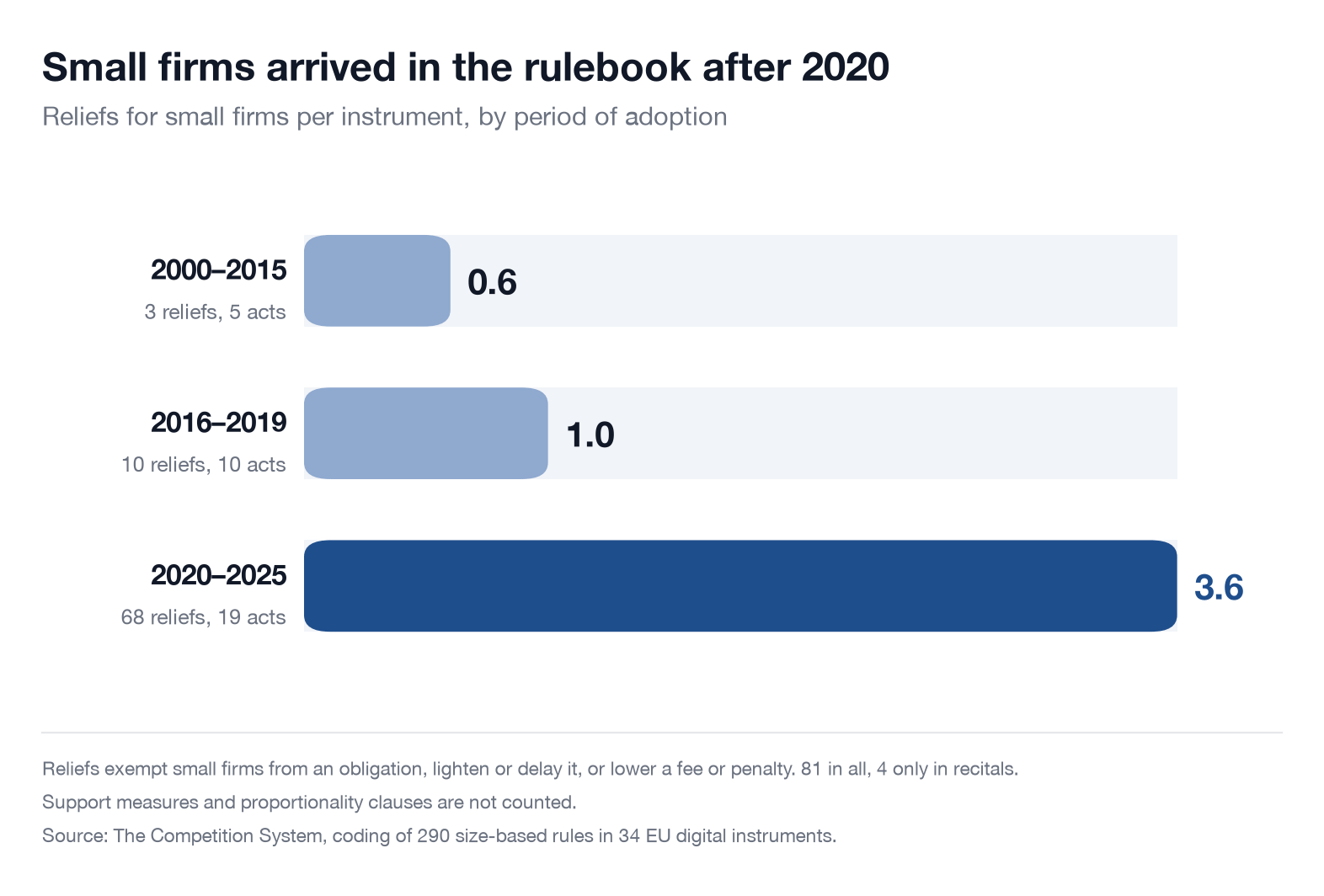
Of the 290 rules, 81 relieve small firms of something, an obligation lifted, lightened or delayed, a fee cut, or a penalty lowered or removed. Seventy-seven of them sit in binding articles, and four only in recitals. Most of the others promise support or ask for size to be taken into account. The attention is recent. Of the five instruments adopted before 2016, one grants any relief. Of the nineteen adopted since 2020, thirteen do. DORA alone accounts for 31 of the 81.
Where the reliefs stop
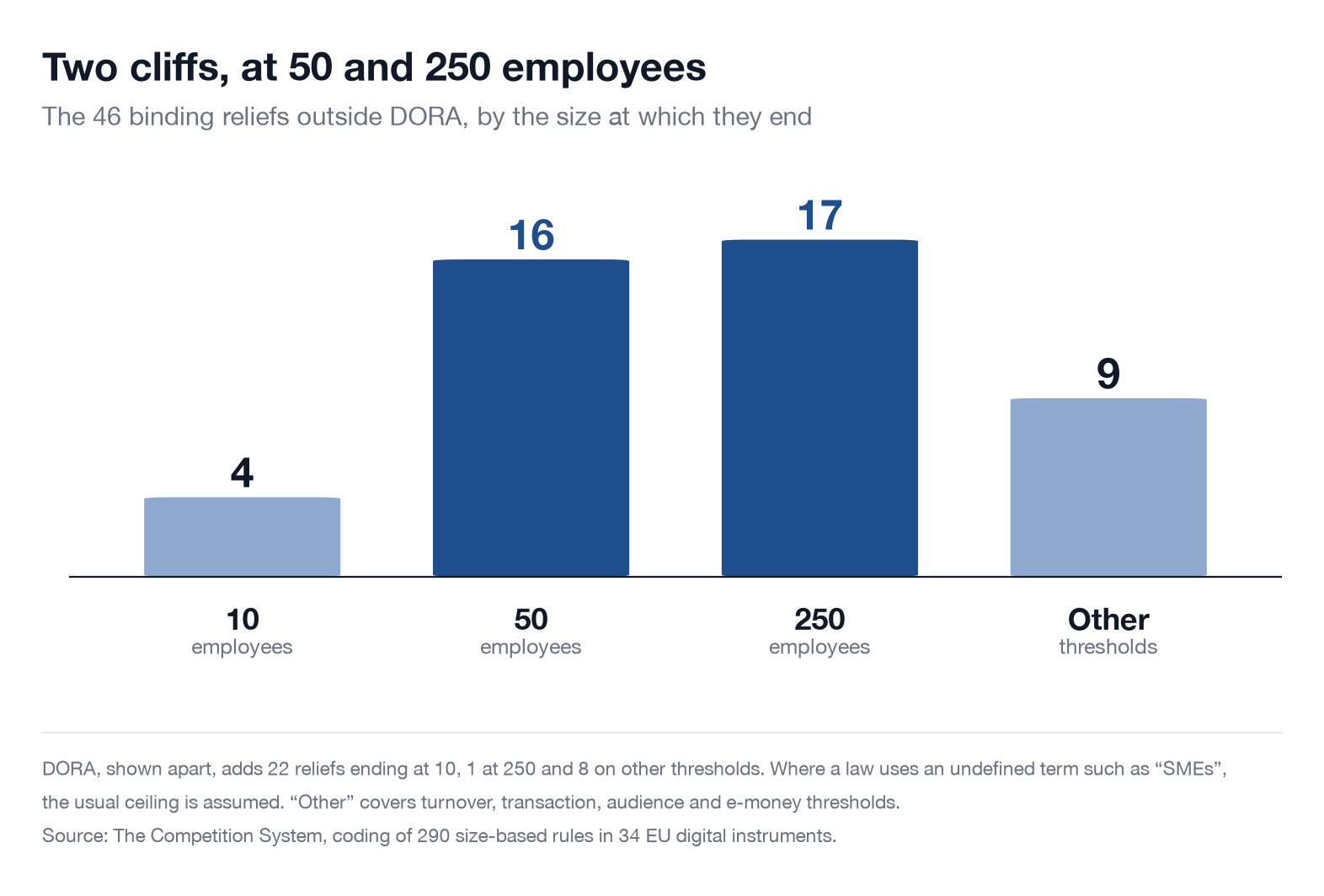
Outside DORA, most reliefs end at 50 or at 250 employees, which gives a growing firm two cliffs. The rulebook rarely softens them. Of the 77 operative reliefs, 50 say nothing about what happens when a firm outgrows its category, and for 7 more the text does not allow an answer. One relief relieves nothing at all. The Cyber Resilience Act spares small manufacturers from fines for a missed reporting deadline by derogating from the wrong paragraphs of its own penalty article (see Exhibit 3).
Same size, different owner
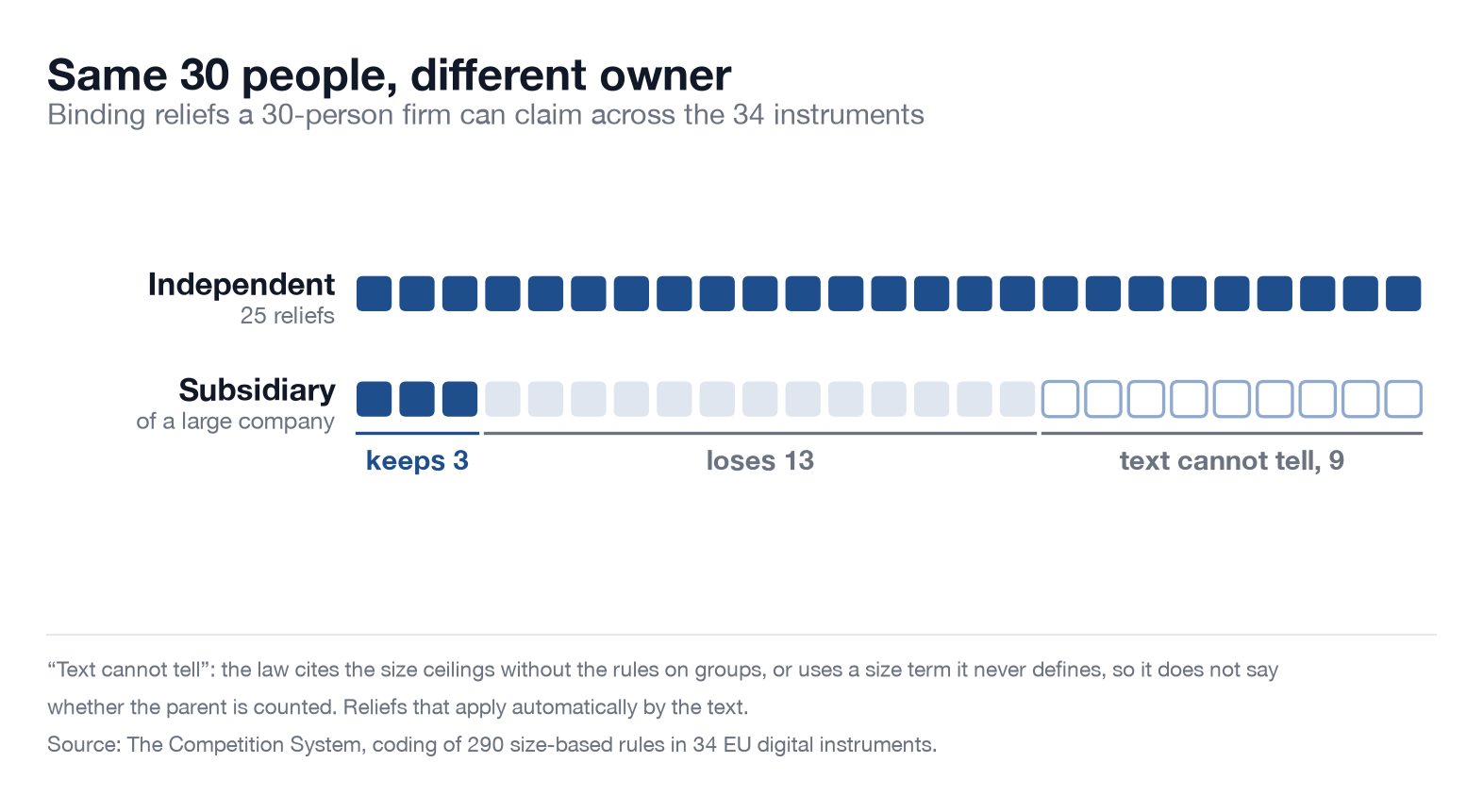
Take two firms of 30 people, each with a turnover under EUR 10 million. One is independent. The other is a subsidiary in which a large company holds a majority of the voting rights. Under Article 3(3) of the annex to the Recommendation the two companies are then “linked enterprises”, and Article 6(2) adds 100 percent of the parent’s staff and turnover to the subsidiary’s. The independent firm meets the size condition of 25 reliefs that apply automatically by the text, provided it works in the sectors those laws regulate. The subsidiary keeps 3 of them, the GDPR’s exemption from keeping records of processing, the Platform Work Directive’s rule on who pays for experts, and a DORA exclusion for small insurance intermediaries, because these laws count the firm’s own staff or define size with no rule on groups. It loses 13. In twelve, the law imports the Recommendation in full, as the DSA and the Cyber Resilience Act do, or writes the group rule out itself, as the Data Act does. The thirteenth, in NIS2, follows by inference, since NIS2 switches off one paragraph of the group rules and so implies that the others apply. For the remaining 9, the text does not say. Six cite only the article of the Recommendation that sets the ceilings, two in the AI Act rest on the undefined term “SMEs”, and one in the EECC refers to “Union law accounting rules” without naming them.
Ownership short of control counts too. A large company that takes a stake of 25 percent or more, without a majority, makes the start-up its “partner enterprise”, and Article 6(2) adds a share of the partner’s staff and turnover in proportion to the stake. A 30 percent stake held by a company of 10,000 employees adds 3,000 people to a 30-person firm. Venture capital is treated differently. Under Article 3(2), venture capital companies, business angels investing less than EUR 1.25 million, universities and institutional investors may hold 25 percent or more without becoming partners, provided they are not linked to the start-up, which a majority of the voting rights would make them. In the laws that import the Recommendation, a start-up financing its growth through a corporate investor can therefore lose reliefs that a venture fund’s money would leave intact.
Where this is heading
The Draghi report also noted that the EU “lacks a commonly agreed definition of small mid-caps”. The legislator’s answer is a new category. In 2025 the Commission defined “small mid-cap enterprises” as firms employing “fewer than 750 persons”. On 9 June 2026, Parliament and Council provisionally agreed, in the omnibus that extends some small-firm reliefs to these firms, on “fewer than 1000 employees”. The Chips Act already uses the same name for a ceiling of 499, borrowed from Horizon Europe. The EU now has three definitions of a small mid-cap, in force or agreed. For the reliefs the omnibus extends, the cliff would move up. The counting problem would stay where it was.
What Pascal would say
Pascal’s test asks whether everyone who uses an undefined word points to the same thing. EU digital law fails it for “small”. The same 30-person firm is small under one law and not under the next, depending on who owns it and on which law is asked. The Draghi report names the cost of rules that apply once a firm reaches a particular size. Part of that cost is the legal work needed to find out, law by law, which of those rules apply. A single definition, applied the same way across the digital rulebook, would cut that cost before any new relief is written.
The audit
The claims above rest on a dataset of 290 coded rules. The audit below sets them out, starting with Exhibit 1, open to all readers, which shows how each of the 29 laws with a size-based rule decides who is small.
THE AUDIT
This study reads the size-based rules as written. It does not measure how authorities apply them or how firms use them. Counts are floors. The first exhibit is open to all readers.
Exhibit 1: How each law decides who is small
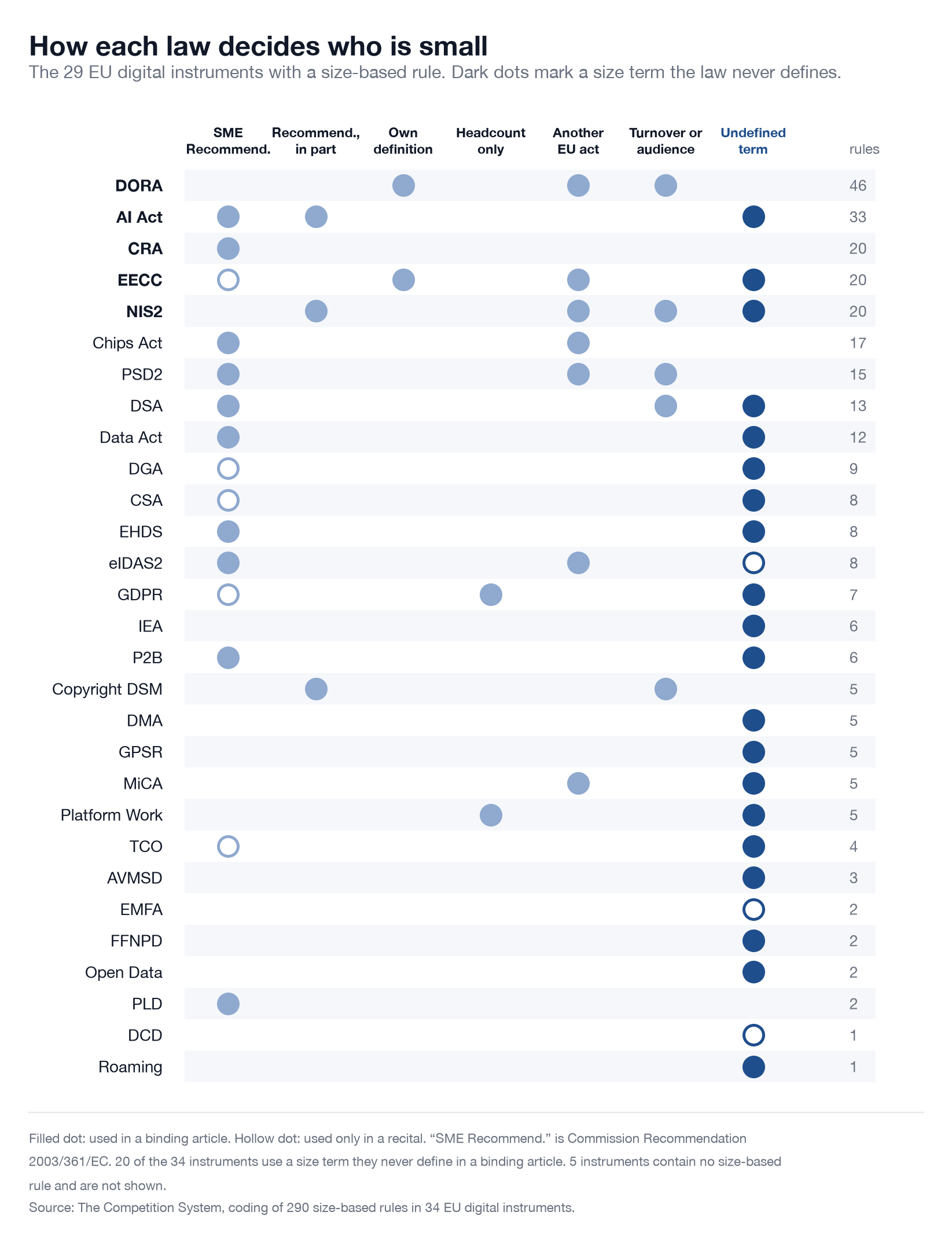
Three patterns stand out.
The densest laws define least. Three of the five instruments with the most size-based rules, the AI Act, NIS2 and the EECC, use at least one size term they never define in an operative provision. Of those five, only DORA and the Cyber Resilience Act define every term they use.
The reference is used by a minority. Seventeen instruments refer to Recommendation 2003/361/EC, five of them only in a recital, so twelve of the 29 do so in a binding article. Twelve instruments with size-based rules never refer to it, and nine of those rely entirely on terms they leave undefined.
Many laws measure size in more than one way. Ten instruments combine two or more defined measures, the Recommendation, their own definitions, headcounts, other EU acts, or turnover and audience. Counting the undefined terms as a further way, eighteen do. A firm can be small under one article and large under the next in the same law.
The reliefs are European. The question that decides whether a firm can use them is answered by 29 instruments in 15 different combinations of methods.
Below the paywall
Five more exhibits follow for paid subscribers. The first two are written for founders and investors preparing a funding round, since a round changes a firm’s size in two ways, through the shareholders it brings in and the hiring it pays for.
Exhibit 2, the same firm, law by law. A 30-person firm is walked through every relief that applies to it by the text, first as an independent company and then as the subsidiary of a large group. The table gives, law by law, the 13 reliefs the subsidiary loses and the 9 on which the text is silent, and it sets the AI Act’s group test against the Data Act’s, which reach opposite results for the same firm. It tells a founder what a corporate investor, rather than a venture fund, would cost in reliefs.
Exhibit 3, what returns at 50 and at 250. For every relief outside DORA, the obligation a firm takes back when it passes each ceiling, and when. The rulebook cushions the step to 50 and leaves the step to 250 bare. A start-up budgeting a round that finances its hiring can read off what compliance comes with the new staff.
Exhibit 4, who decides who is small. Thirteen reliefs are left to Member States or authorities, and in three of them the size threshold itself is national. Written for lawyers advising firms active in several Member States.
Exhibit 5, when small is not enough. The eighteen rules that take a relief back from a small firm, sorted by trigger. Audience, a type of service, a national designation, or a single sentence announcing a token listing can each cost a small firm its relief.
Exhibit 6, the errors and the fixes. Two drafting errors, one in the Cyber Resilience Act and one in DORA, and nine amendments, each tied to the article it would change. Written for the officials and members of Parliament working on the omnibus.
The note on method, with the full blind double coding and the sensitivity of every figure, is there for researchers who want to test the numbers. The audit is what a paid subscription supports.
