

A new study of the 34 binding instruments of the EU digital rulebook, after the six on definitions, institutions,rules written elsewhere, penalties, reach and small firms.
**
Apple’s new business terms for apps in the European Union took effect on October 1, 2026. A developer that sends a user out of its app to buy something on its own website now pays Apple 15% of any sale concluded within seven days of the tap, and 5% of sales made in apps distributed outside the App Store. The Digital Markets Act, in Article 5(4), says that a gatekeeper “shall allow business users, free of charge, to communicate and promote offers” to their users “and to conclude contracts with those end users”. Seventeen months earlier the Commission had fined Apple EUR 500 million for restricting steering and charging a commission on the sales that followed. In August 2026, a Commission spokesperson said the Commission welcomed the new terms. Apple describes its commissions as reflecting “the extensive value Apple provides developers”. Epic Games, in press reports, calls them junk fees. This piece takes no side in that dispute, and no position on whether gratuity is a good regulatory instrument. It measures what the texts say.
Marcel Mauss, the French sociologist, published an essay on the gift in 1925. He had read the ethnographies of the Pacific and the American Northwest and found the same pattern in each. A gift is presented as free and voluntary, and it is neither. It obliges the receiver to accept and to return, and the return is where the value changes hands. Mary Douglas, introducing the English edition in 1990, put the finding in three words, no free gifts.
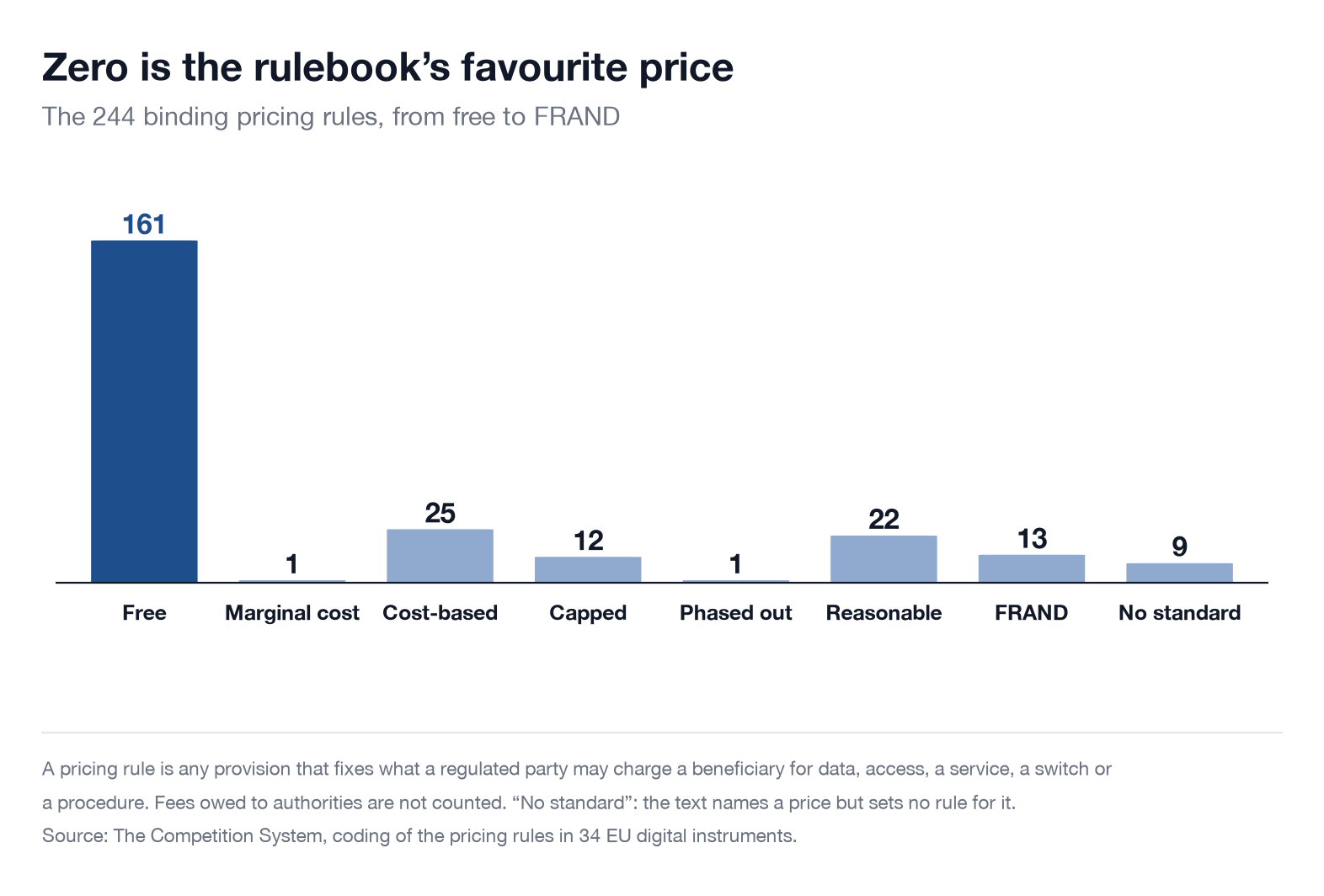
EU digital law is full of gifts. I wanted to know what they oblige. So I coded every provision in the 34 binding instruments of the EU digital rulebook that fixes what a regulated party may charge a beneficiary for data, access, a service, a switch or a procedure, 244 pricing rules in all. Two thirds of them, 161, set the price at zero.
Zero is the rulebook’s favourite price
The rulebook knows other prices. It can require cost-based fees (25 rules), a price that is “reasonable” (22), a cap (12), terms that are “fair, reasonable and non-discriminatory” (13), or marginal cost (1). It uses each of them less often than it uses zero. Gratuity is the rulebook’s standard way of allocating a cost between a firm and the people and businesses it deals with, and 126 of the 161 gratuity rules bind private firms.
What is made free is mostly modest. 50 rules give free access to data, a service or a feature, forty give free information, a copy, a bill or a notice, and 34 make a procedure free, a complaint, a termination, a correction. Only 10 rules make an act free, something the beneficiary does and the obligated firm must let it do without charge. Six of those are in the ePrivacy Directive of 2002 and concern a subscriber withholding a phone number, refusing the processing of location data or declining marketing. One is the DMA’s steering rule. It is the only free act in the corpus whose purpose is a sale.
Free of what, exactly
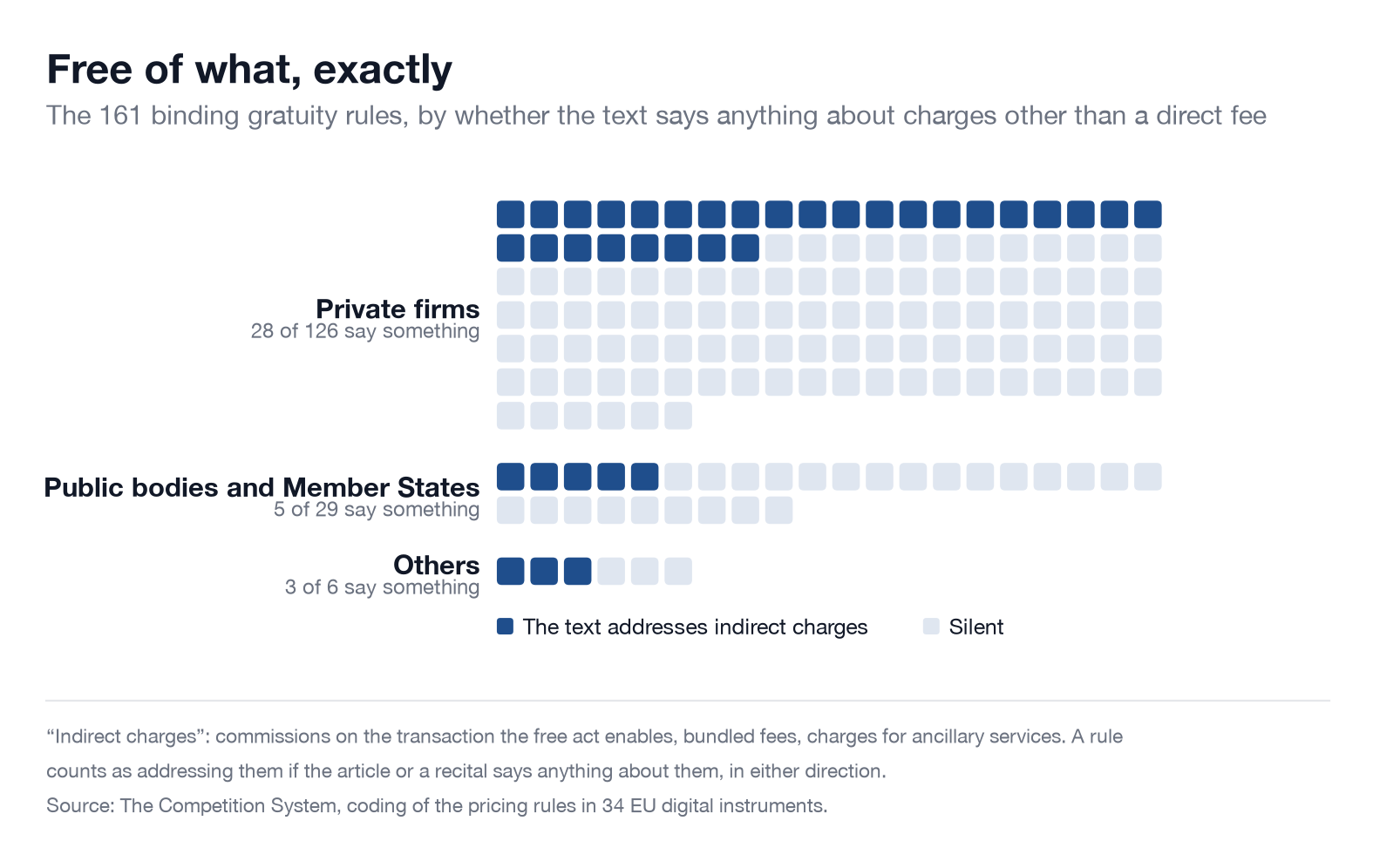
A rule that makes something free of charge rarely says what charge it has in mind. Of the 161 gratuity rules, 125 say nothing, in the article or in any recital, about charges other than a direct fee for the free item, nothing about commissions on the transaction the free act enables, bundled fees or charges for ancillary services. For the rules that bind private firms the share is the same, 98 of 126.
The legislator can be precise when it wants to be. The European Health Data Space Regulation, in Article 18, provides that a healthcare provider “shall not directly or indirectly charge data subjects a fee or costs, or require compensation” for sharing or accessing health data. The Electronic Communications Code, in Article 106(4), requires that “no direct charges are applied to end-users” for porting a number, and leaves the indirect ones to the general tariff. The Data Act prices the same data three ways, free of charge to the user who requests it (Article 4), “free of charge to the user” but against reasonable compensation from the third party who receives it (Articles 5 and 9), and free of charge to a public body in an emergency (Article 20). These are the exceptions. Most gratuity rules say free, and stop.
The one case where the legislator said what it meant
The DMA’s steering rule is among the silent ones. Article 5(4) attaches “free of charge” to communicating, promoting and concluding contracts, and says nothing about a commission on the contract concluded. Recital 40 adds only that the gatekeeper may have been “directly or indirectly remunerated” for “the initial acquisition of the end user”. All ten of the DMA’s binding gratuity rules are silent in this sense, and all ten are protected by the anti-circumvention clause of Article 13, which forbids any “behaviour that undermines effective compliance”.
The silence was not an oversight. The Commission’s 2020 proposal contained no “free of charge” at all. The Council added it. A note from its Secretariat General of 18 March 2022, quoted in the Commission’s decision of 23 April 2025, explains that the words were inserted to prevent gatekeepers from circumventing the obligation “en fixant une commission pour les transactions réalisées en dehors du service de plateforme essentiel”. The decision drew the consequence. Article 5(4) “clearly provides that the gatekeeper cannot impose a fee for steering and for steered transactions”. A gatekeeper may be paid for the initial acquisition of a user, but that payment “must be linked in time to the actual facilitation of such initial acquisition” and “cannot apply throughout the overall lifetime” of the relationship. The Commission found that Apple’s 2024 terms, which charged 17 percent on sales concluded within seven days of each link-out, for as long as the user kept the app, did not meet that test. Apple contests the decision before the General Court.
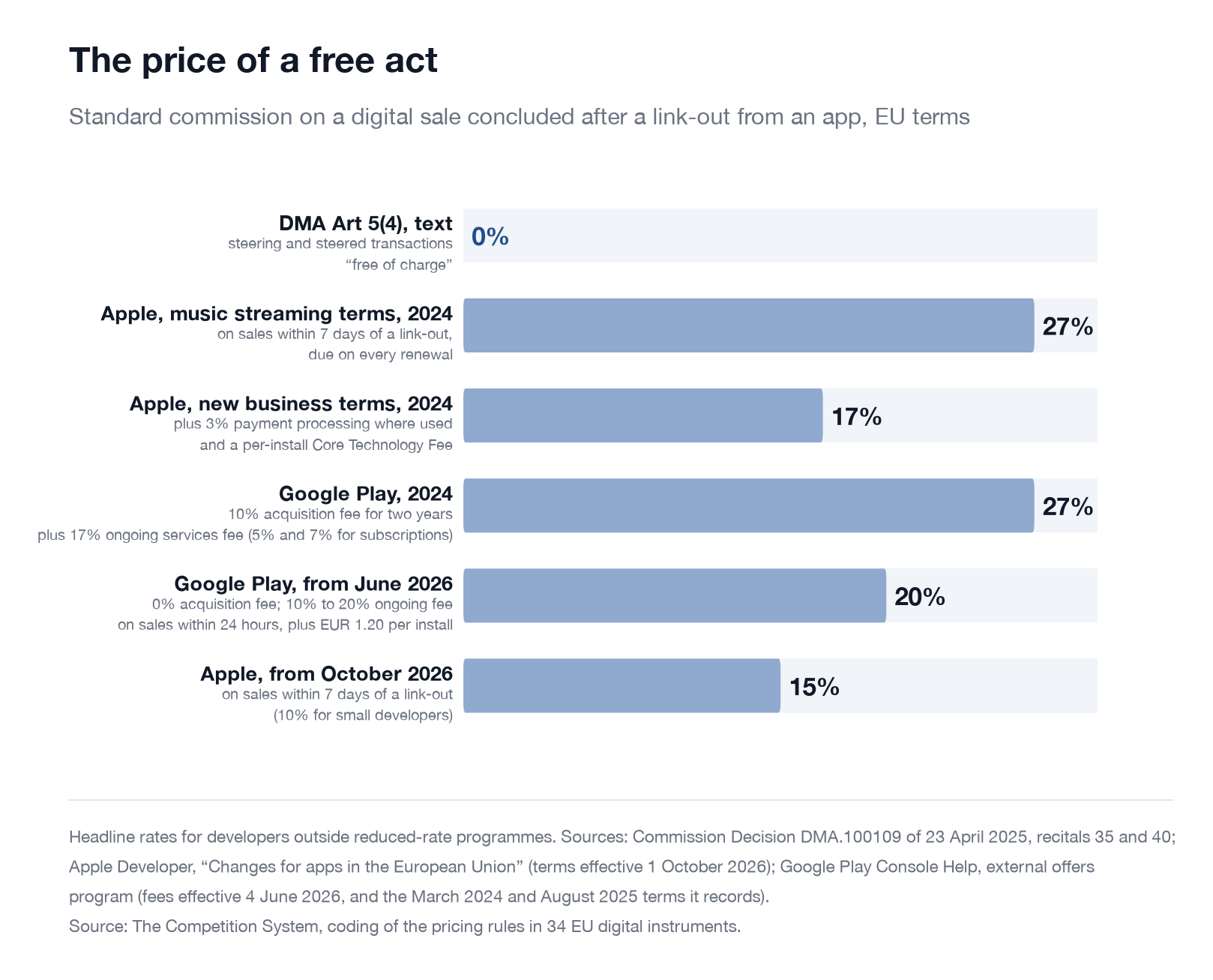
Apple’s October 2026 terms charge 15% on sales concluded within seven days of each link-out. Google’s terms for the European Economic Area, in force since June 2026, set the acquisition fee at zero and charge 10 to 20 percent on sales made within 24 hours of an external link, plus EUR 1.20 per install. Both app store gatekeepers now price the steered transaction by a commission with a time window attached. Whether a window attached to each link-out, rather than to the acquisition of the user, satisfies the decision is a question no published act has answered, and this piece does not answer it either. The Commission has welcomed Apple’s terms through a spokesperson and said it will monitor their implementation. Apple’s appeal against the decision, T-438/25, is pending before the General Court. Both readings of the text remain open until a court or a published act closes one of them.
What Mauss would say
Mauss did not think gifts were a fraud. He thought the obligation to return was the point, and that a society which forgot it would misread its own exchanges. The EU rulebook writes “free of charge” 161 times and, in 125 of them, does not say what the gift obliges. In the one case where the legislator wrote down what it meant, the text still said only “free of charge”, and a 67-page decision, now under appeal, was needed to say whether a commission on the sale is a charge. The steering rule is not the exception in the corpus. It is the first of the 125 silences to be tested, and the test is not over. Whatever its outcome, the finding of this study is about the texts, which leave the question to the enforcer 125 times.
**
The claims above rest on a dataset of 334 coded rules. The audit below sets them out, starting with Exhibit 1, open to all readers, which shows where in the rulebook gratuity sits and which laws use it most.
THE AUDIT
This study reads the pricing rules as written. It measures how gatekeepers apply one of them, the DMA’s steering rule, through their published terms, and does not measure the others in practice. The first exhibit is open to all readers.
Exhibit 1: Where the rulebook says free
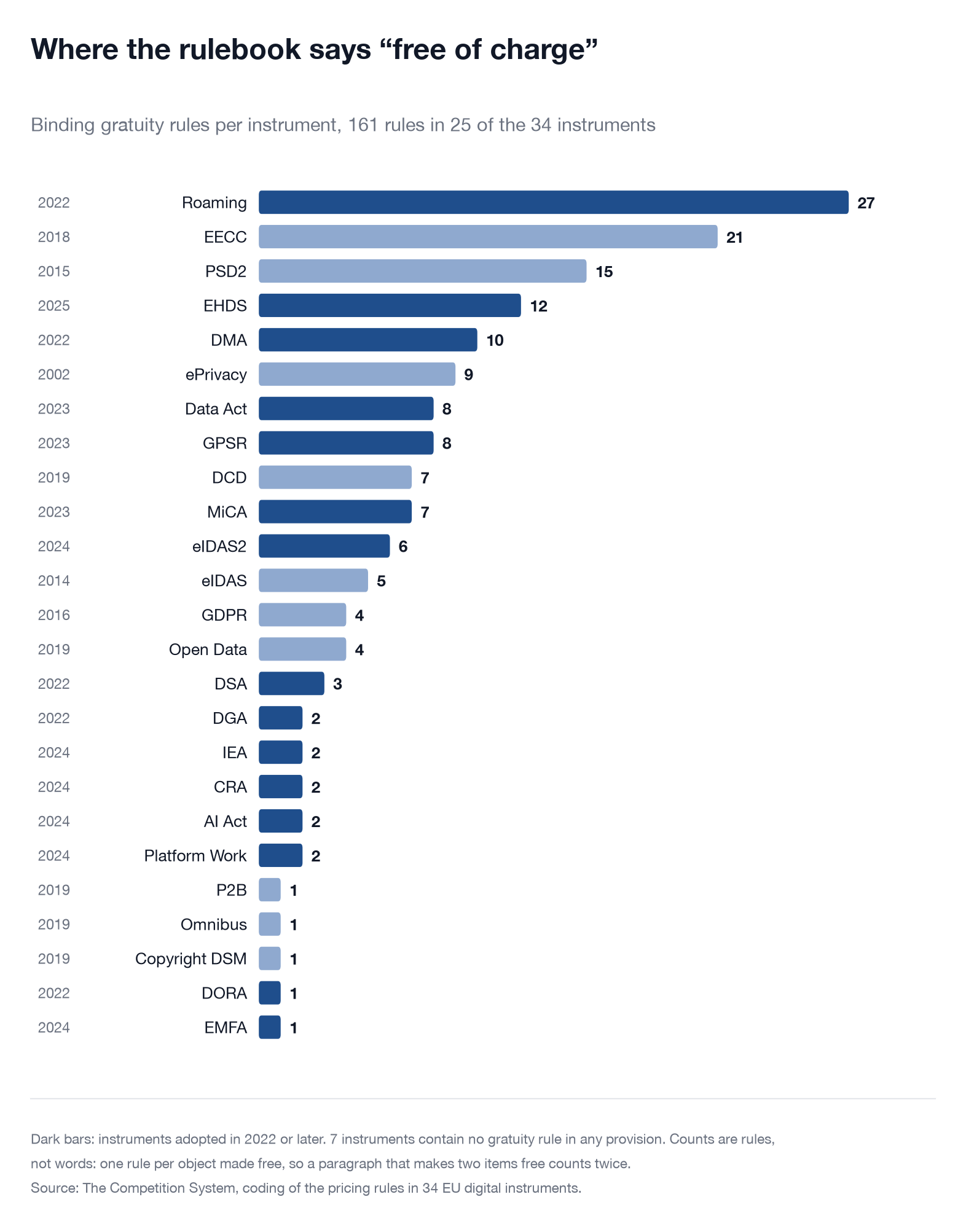
Three patterns:
Gratuity is a telecoms habit that spread. The Roaming Regulation and the Electronic Communications Code hold 48 of the 161 binding gratuity rules between them, and the ePrivacy Directive of 2002 another nine. The instruments of 2020 and after hold 93, in 16 of the 19 instruments of that period. The Data Act, the DMA, MiCA, the Health Data Space and the Product Safety Regulation each use gratuity on business models that did not exist when the telecoms rules were written.
Seven laws never make anything free. The Cybersecurity Act, the Free Flow of Non-Personal Data Regulation, the Terrorist Content Regulation, the Open Internet Regulation, the Audiovisual Media Services Directive, the Product Liability Directive and the Chips Act contain no gratuity rule in any provision. The Open Internet Regulation’s only pricing rules amended the 2012 Roaming Regulation, since repealed, and are counted under the 2022 Regulation that replaced it.
The beneficiary is usually a person. 109 of the 161 rules benefit an end user, a consumer, a data subject, a user of a connected product or a worker. Thirty-four benefit a business, a business user, a third-party provider or a re-user of public data. The DMA holds the largest block of the latter, and every one of its business-side gratuities faces a gatekeeper.
Below the paywall
Six exhibits follow for paid subscribers.
Exhibit 2, what is made free. The 161 rules sorted by the kind of thing made free, the laws where each kind is densest, the ten rules that make an act free, and who bears the cost. For lawyers who need to know whether a “free of charge” clause in their sector reaches a commission, a bundled fee or an ancillary charge.
Exhibit 3, the pricing spectrum. Every rung from free to FRAND with its rules, and the four instruments that price the same object differently for different beneficiaries. For anyone drafting or negotiating a data-sharing or access agreement under the Data Act, the Open Data Directive or the Health Data Space.
Exhibit 4, the silences. The 36 rules that say something about indirect charges, what they say, and the 125 that say nothing, sorted by sector. The handful of clauses that use the word “indirectly”. For officials and members of Parliament who will draft the next “free of charge”.
Exhibit 5, everything the DMA says about free. All 18 provisions of the DMA that speak to price, the 12 gratuities, the 2 FRAND rules and the 4 that decide whether a free service counts as a market, with who benefits, what is free, which conditions attach and which obligations the Commission can specify by implementing act. For anyone advising a gatekeeper or a business user on what Articles 5 to 7 give away.
Exhibit 6, Article 5(4), text against practice. What the decision of April 2025 held, what Apple and Google charge today, and the two sentences, one for each reading, that would make the article say what it means. For the Commission’s DMA team, the gatekeepers’ counsel and the developers who pay the commissions.
Exhibit 7, the rulebook as a network. The 34 instruments drawn as a graph of 905 concepts and 925 relations, and what the graph shows about gratuity. The instruments that use it most are not the hubs, their pricing rules never cite one another, and a method that reads the rulebook as a network sees 161 gratuity rules as three nodes. For readers who want to know what network analysis adds to the reading of a legal corpus, and what it misses.
The note on method, with the full blind double coding and the sensitivity of every figure, is there for researchers who want to test the numbers. The audit is what a paid subscription supports.
