
Descartes opened his method with a refusal. The first of his four precepts was “never to accept anything for true which I did not clearly know to be such”, and to admit into judgement nothing that was not presented “so clearly and distinctly as to exclude all ground of doubt”. The Digital Markets Act was written on the opposite precept. Where three numbers are met, the Commission accepts as true that a company is a gatekeeper, and the company must dislodge the belief.
On 15 October 2026, Advocate General Biondi delivered the first opinion in a DMA case to reach the Court of Justice, Bytedance v Commission, and spent the first fifty‑seven points on what it takes to dislodge that belief. His answer is a “high degree of plausibility”. That asks more of the company than Bytedance wanted, which was that doubts should suffice, and less than the DMA’s own words “exceptionally” and “manifestly” seemed to promise, which was something close to certainty.
The opinion proposes to dismiss the appeal. Two limits should be stated before anything else. The Court asked the Advocate General to address only the first and third parts of the first ground of appeal and the Commission’s request for a substitution of grounds (point 11), so three parts of Bytedance’s case have no opinion at all. And an opinion is not a judgment. What follows reads the opinion as a text, against the record, and says what the Court would be adopting if it followed it.
The Competition System is about competition law, and the DMA is, by its own account, not competition law. With Godefroy de Boiscuillé, I have argued elsewhere, from the enforcement record of 2024 to 2026, that the DMA’s operative content is unilateral conduct control of the Article 102 kind under a harmonization label, and that the regulation delivers the same outcomes as Article 102 at a lower evidentiary cost (Questioning the Digital Markets Act’s Legality). That paper looked at the obligations and the fines and set the designation machinery aside, as the one part of the DMA with no counterpart in Article 102. This opinion is about that machinery, and, if anything, it reinforces the argument. The designation stage borrows the one concept it shares with Article 102, the ecosystem, from an Article 102 judgment, and discards the evidentiary discipline that comes with it, the burden on the authority, the ordinary standard of proof, the open evidentiary window and the hearing on the objections. An instrument that keeps the vocabulary of competition law and drops its method is what the paper described from the enforcement end. The opinion shows the same design at the entrance.
The method, in four sentences
The opinion’s 186 points were matched to the paragraphs of the General Court judgment they review and to the sixteen judgments they cite, each checked at the paragraph in the corpus or on EUR‑Lex. Three words the opinion turns on, “ecosystem”, “multi‑homing” and the standard of proof, were then searched across the 1,061 judgments of the corpus and the 8,859 Commission merger decisions in a companion corpus. The judgments the opinion does not cite were located by their distance in the graph from the ones it does, so that the omissions could be listed rather than guessed at. Above the paywall, paragraph numbers refer to the opinion unless another text is named. Below it, every passage is reproduced verbatim.
The opinion in four points
The first point concerns the standard of proof, and where the Advocate General found it. Article 3(5) of the DMA lets a company that meets the thresholds present “sufficiently substantiated arguments” that “manifestly call into question” the presumptions. Bytedance said that doubts or prima facie evidence should suffice to force a market investigation. The General Court had said the arguments must show “with a high degree of plausibility” that the presumptions are called into question, and had twice used the word “exceptionally” on the way (General Court, paragraphs 70 and 71). The Advocate General calls that word “unfortunate” (point 43) and keeps the standard, restated in words of his own (point 36). The arguments “have to be genuinely compelling, with no easily identifiable weaknesses in their capacity to rebut the presumption”. He adds one thing the General Court had not said. The third subparagraph of Article 3(5) provides that, where a company does present such arguments, the Commission “may” open a market investigation. On the Advocate General’s reading the word gives the Commission no choice. It “cannot reject those arguments without opening a market investigation” (point 23).
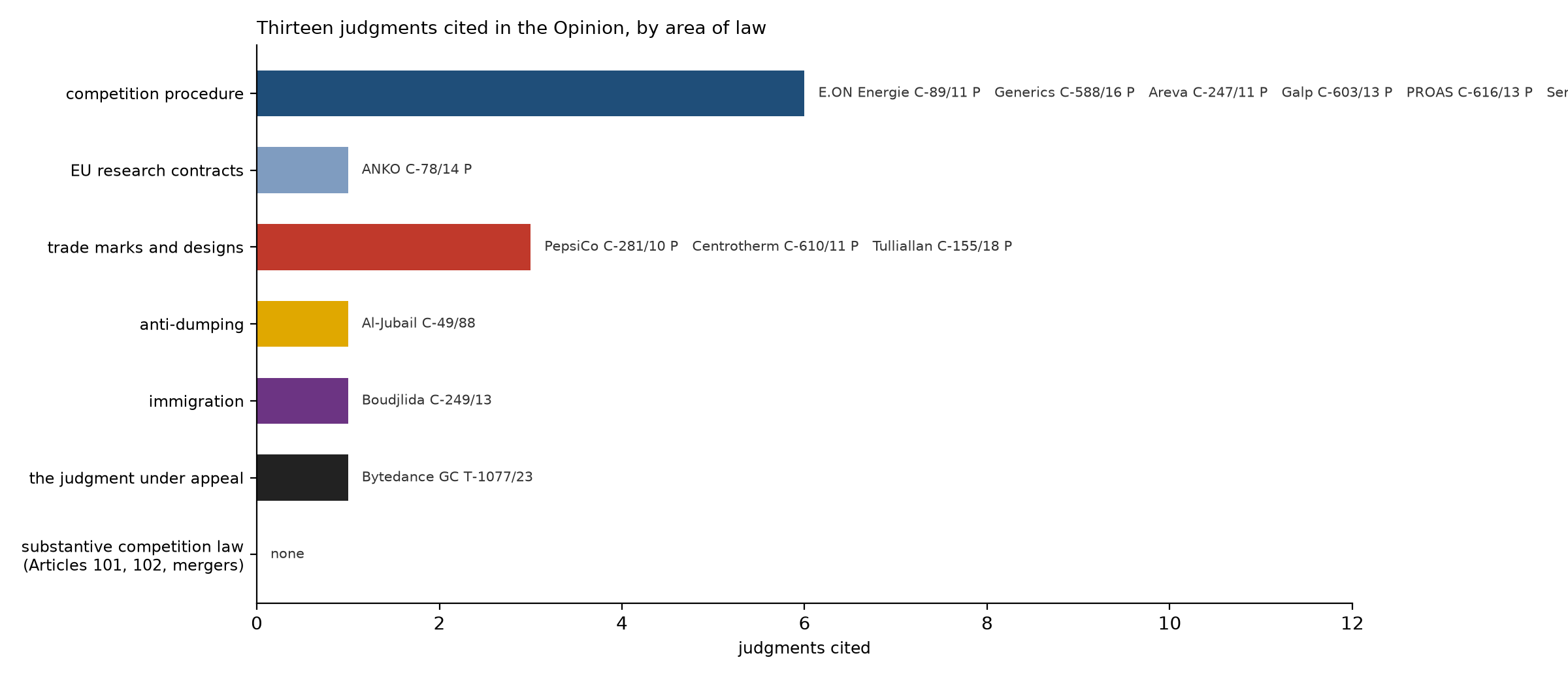
Where does that standard come from? Not from competition law. The opinion cites twelve judgments under sixteen case numbers. Six are competition cases, every one of them cited for a point of appellate procedure, the scope of review, distortion of evidence, the duty to state reasons. Three are intellectual property cases, two on trade marks and one on designs, cited for what distortion of evidence means and for what the right to be heard does not require. One is an anti‑dumping case, one concerns the return of an illegally staying migrant, one is a dispute over an EU research grant. Not one is cited for what Article 102 says about proving or rebutting dominance, and not one is a merger case. The corpus confirms the gap from the other side. The phrase “high degree of plausibility” appears in exactly one of the 1,061 judgments, the Bytedance judgment under appeal. So does “manifestly call”. The DMA’s standard of proof has a pedigree of one.
What would the standard have looked like if it had been built on Article 102? Under Regulation 1/2003 the burden of proving an infringement rests on the authority. The Court has accepted since Hoffmann‑La Roche that very large market shares are in themselves evidence of dominance “save in exceptional circumstances”, a presumption the Commission must still build a decision around and the company rebuts under the ordinary rules of evidence. Since Intel in 2017, where a company submits evidence during the administrative procedure that its conduct could not foreclose, the Commission must analyse it. Since Galp, PROAS and Servier, a company may put evidence before the General Court for the first time. Bytedance cited the last three. The Advocate General answers that under the DMA all rebuttal material must come with the notification and nothing later (points 130 and 131). On each of the four variables, who bears the burden, how strong the showing must be, when the evidence can be produced, and what the authority must do with it, the DMA as read by the opinion is the inverse of Article 102. That is not an error in the opinion. It is the design of the regulation, which the opinion calls at point 2 “a familiar legislative technique”. The technique is familiar from anti‑dumping, trade marks and immigration, not from the law of dominance, and the opinion’s citations say so.
The graph adds what the citations leave out. Start from the four competition judgments the opinion does cite, Generics, Galp, PROAS and Servier, and walk outward. One edge from PROAS sits Eni, which restates the Court’s rule on rebuttable presumptions, and behind it Elf Aquitaine, where the Court held that a presumption remains within acceptable limits only so long as evidence to the contrary can be adduced and the rights of the defence are safeguarded. Two steps away sits Aalborg Portland, which lets the facts require a company to explain itself but keeps the legal burden on the Commission. At the standard‑of‑proof node sit Impala and CK Telecoms, which fix what the Commission must show to prohibit a merger, that harm is more likely than not. None of these is in the opinion. The audit lists eight such judgments and what citing each would change. None makes the opinion wrong. Four would have given it a competition‑law source for what it holds. Three would have forced it to say out loud what it leaves implicit, that a company must show more to escape designation than the Commission must show to block a merger, and must do so without the hearing Elf Aquitaine makes a condition of the presumption’s validity.
The same borrowing decides the second ground of appeal. The General Court had found that the Commission infringed Bytedance’s right to be heard on two findings and had refused to annul because the outcome would not have changed (General Court, paragraphs 353 and 370). The Advocate General finds no infringement at all. Article 34(1) and (3) of the DMA, which govern the hearing before a decision, do not apply to a designation made on the presumptions alone (points 146 to 150). The Charter applies, but it does not oblige the Commission to disclose its provisional assessment of the company’s own evidence before deciding (point 159). The authorities for that are a trade‑mark appeal and the migrant case. The General Court had cited Slovak Telekom for the same right. The opinion keeps the right and drops the source. The reader may compare Article 27 of Regulation 1/2003, under which the Commission “shall base its decisions only on objections on which the parties concerned have been able to comment”. The opinion concedes that the boundary it draws “may be difficult to draw” (point 160).
The second point concerns the word “ecosystem”, and it reaches beyond the DMA. Since 2024, the word has been given content in three places. The General Court in Bytedance defined it from the DMA’s recitals as a space where “several categories of suppliers, customers and consumers are brought together and interact within a platform” whose products “may overlap with, or be connected to, each other in terms of their horizontal or vertical complementarity” (General Court, paragraphs 128 and 129). The Advocate General endorses that definition (point 60). The General Court in Booking/eTraveli, last month, in a judgment analyzed here, used “travel ecosystem” seventeen times and defined it nowhere, treating it as a thing Booking’s internal documents said would be “difficult for competitors to replicate”. And the Commission’s draft merger guidelines (analysis here) make an ecosystem the setting for a new head of harm, entrenchment, and define it in a footnote as “a primary core product and several secondary (digital) products whose consumption is connected to the core product”, citing the General Court’s Android judgment as the example.
Set the texts side by side and one thing stands out. The General Court’s DMA definition at paragraph 129 of Bytedance is, almost word for word, its Article 102 definition at paragraph 116 of Google Android in 2022, “a digital ‘ecosystem’, which brings together several categories of supplier, customer and consumer and causes them to interact within a platform”. Bytedance does not cite Android. It attributes the sentence to the DMA’s recitals. The DMA’s first judicial definition of an ecosystem is therefore an Article 102 definition travelling under a new name. The record behind the word is thin. “Ecosystem” appears in 7 of 1,061 judgments and in 69 of the merger cases in the decisions corpus, 52 of them since 2016 and none before 2008. A concept the Court of Justice has itself used as a legal category once, at paragraph 273 of Android this July, now anchors a designation regime, a merger prohibition and a draft head of harm.
The third point concerns multi‑homing, i.e., the fact that users use several competing services in parallel. Bytedance’s central factual argument was that 77 to 82 per cent of TikTok’s users also use Facebook or Instagram, so TikTok locks nobody in.
The General Court answered that high multi‑homing says nothing about intensity of use and that the asymmetry is explained by Facebook and Instagram having been there first. Lock‑in “may arise even in the presence of multi‑homing” (General Court, paragraphs 179, 198 and 200). The Advocate General holds that Bytedance is “incorrect to assert that there is necessarily a link between multi‑homing and a lack of lock‑in effects” (point 111). Booking made the same argument to the same court two years later about hotels listing on several agencies, and did better without it changing anything. The General Court held that the Commission had failed to examine Booking’s evidence that hotels use channel managers to list on many agencies at once, so that its finding that hotels would drop rival agencies was unsubstantiated (Booking, paragraphs 415 to 417). It then upheld the prohibition on an overall assessment of the rest of the evidence (paragraph 473). Before the EU Courts the argument has been rejected on the merits once, endorsed as rejected by the Advocate General, and in Booking it won a point about the Commission’s method that left the outcome untouched.
Before the Commission it is a different story. The term appears in 41 merger decisions between 1998 and 2025. In 19 of them the Commission relied on multi‑homing to dismiss or reduce a concern, Facebook/WhatsApp, Microsoft/GitHub and Amazon/MGM among them. In 7 it rejected the argument, and the seven include all three prohibitions in the set, MCI WorldCom/Sprint, Deutsche Börse/LSE and Booking/eTraveli, with Microsoft/LinkedIn, Meta/Kustomer and Broadcom/VMware, which ended in commitments. The Courts only see the second group, because nobody appeals a clearance, so the Luxembourg record is a selected sample. But the selection cuts one way. The argument that wins at the Commission has not yet changed an outcome at the Court, and the opinion, if followed, will make it the law of the DMA that it cannot win on its own.
The fourth point is about what the opinion leaves to the Court. It says nothing on three parts of the first ground, because the Court asked it not to. It says nothing on the paragraph of the General Court judgment that Booking/eTraveli relied on last month, paragraph 40, which holds that quantitative and qualitative evidence cannot be neatly separated, so if the Court follows the opinion that paragraph survives untouched and the Booking judgment’s use of it stands. And it says something the General Court had not said, in the company’s favour, that a sufficiently substantiated challenge obliges the Commission to open a market investigation. The next gatekeeper to notify will cite point 23. The Commission will cite point 36. Both will be right, and the Court will have to say which sentence governs.
What the opinion settles
Descartes refused to accept as true what he could not see clearly. The DMA accepts as true what three numbers say, and the opinion makes the company’s road back a steep one, with a standard of proof that has no source in competition law and a right to be heard borrowed from trade‑mark and immigration cases. The evidentiary window closes with the notification. None of that is a criticism of the Advocate General, who read the regulation as it was written. It is a description of what the regulation is. If the Court follows him, the first thing the DMA will have established at the highest level is that its procedure owes nothing to Articles 101 and 102, and the second is that the one concept it shares with them, the ecosystem, was copied from an Article 102 judgment without saying so. The regulation that disclaims competition law has borrowed its vocabulary and declined its method, and the judgments that would have supplied the method sit one or two edges away in the graph. The audit names them. 4. Descartes would have called that a judgment reached with the doubt still in it. The regulation calls it designation within 45 working days.
**
What follows below the paywall is the audit that sustains the four points above. It is written to be dropped into a brief. If you advise a company that will notify under the DMA, sit in an authority that will read the next designation, or write about the DMA for a living, this, I hope, should help:
Five figures. Where the opinion’s law comes from, judgment by judgment. The omissions map, drawn from the graph. The ecosystem matrix. The multi‑homing ledger across 27 years of merger decisions. The two words that exist in one judgment only.
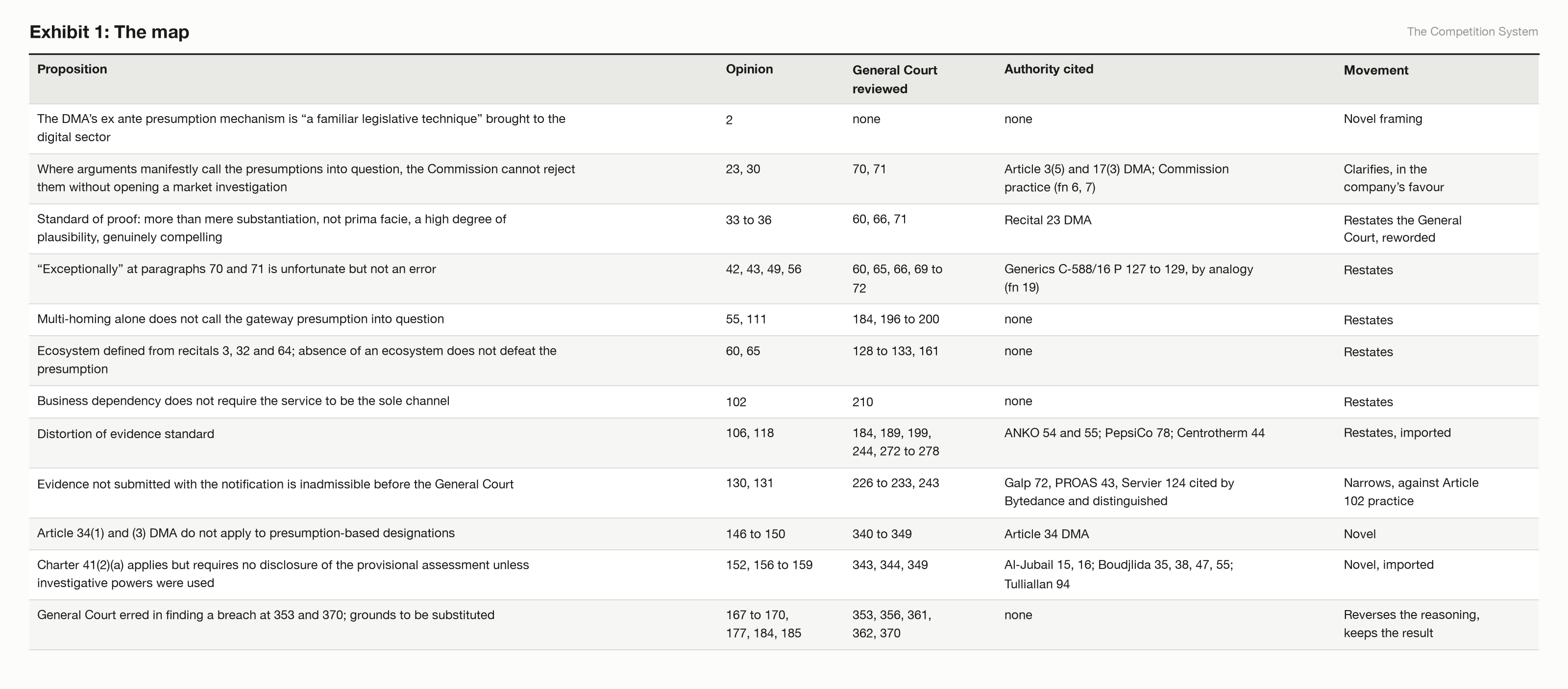
The opinion in one table, proposition by proposition, each mapped to the General Court paragraph it reviews and the authority it cites, marked restates, narrows or innovates, so you can see in one screen where the Advocate General added law and where he copied it.
The standard‑of‑proof passages verbatim, opinion against judgment, beside the Article 102 passages that would have governed the same question, Regulation 1/2003, Hoffmann‑La Roche, Intel, Galp and Servier. Four variables, two columns.
The omissions map. Eight judgments that sit one or two edges from the opinion’s own authorities and never appear in it, each quoted at the paragraph, with whether it helps or hurts the opinion and what citing it would change. It ends with the three paragraphs the next notification should cite, and the one the Commission will not want cited.
Every judgment the opinion cites, checked at the paragraph, with the area of law and the fit, and the finding that not one is cited for a rule of competition law.
Five definitions of “ecosystem” side by side, Android, Bytedance, the opinion, Booking and the draft merger guidelines, with the sentence the General Court copied from its own Article 102 judgment without saying so, and the counts over time in 1,061 judgments and 8,859 decisions.
The multi‑homing ledger. Forty‑one Commission decisions since 1998 coded as accepted, rejected or descriptive, with the names, the three Court passages, and the pattern that explains why it wins in Brussels and has not yet changed an outcome in Luxembourg.
The right to be heard, with the trade‑mark and immigration paragraphs the opinion built it from, set against Article 27 of Regulation 1/2003. Then five predictions on what the Court will do, dated, to be scored at judgment.
**
The audit
Opinion delivered 15 October 2026 (original language English) on the appeal against the General Court’s judgment of 17 July 2024 in T‑1077/23, which upheld the Commission’s decision of 5 September 2023designating Bytedance a gatekeeper for TikTok under Article 3 of the DMA. Hearing 12 May 2026. The opinion addresses, at the Court’s request, the first and third parts of the first ground of appeal and the Commission’s request for substitution of grounds (point 11), and proposes dismissal (points 185 and 186). Corpus, 1,061 judgments of the Court of Justice and the General Court, and 8,859 Commission merger decisions. Point numbers refer to the opinion, paragraph numbers to the General Court unless another text is named. Quotations are verbatim from the official English texts.
Exhibit 1: The map