

“People of the same trade seldom meet together, even for merriment and diversion, but the conversation ends in a conspiracy against the public, or in some contrivance to raise prices.” Adam Smith wrote that in 1776. He then said what the law should do about such meetings. “But though the law cannot hinder people of the same trade from sometimes assembling together, it ought to do nothing to facilitate such assemblies, much less to render them necessary.”
This summer, frontier AI labs did exactly what Smith foresaw. They asked the law to facilitate the assembly. On 12 September, Dario Amodei published an essay calling on the industry to slow down together, and asking Washington for an antitrust waiver that would let it. Sam Altman, Elon Musk and Demis Hassabis agreed the same day. Six days later, paying users of ChatGPT, Claude, Grok and Gemini sued Anthropic, OpenAI, xAI and Google in San Francisco over an agreement to restrict output.
The Competition System studies EU developments, so why talk about an US case? Because I believe a similar question will, sooner or later, be faced by every competition specialist in Europe: how can competition address the claim that competition itself is dangerous? This claim is not necessarily frivolous because increased competitive rivalry leads to increased number of actors, expansion of the attack surface, and delegation of the safety-critical design to smaller number of actors may be more efficient in some technological contexts. The question is not whether this premise can be true; it can be. The question is who is authorized to decide whether it is true, and on what basis.
This contribution explores empirically whether the argument would most likely be successful from the point of view of Article 101 of the Treaty on the Functioning of the European Union. The empirical data is quite clear: no agreement between competitors was upheld on the ground of the public interest since 2006. The below-paywall audit is designed to be easily reused in other cases where the argument is presented.
But before, let me give my initial opinion on the matter. I share it for transparency although it’s irrelevant to what follows. The laboratories have not convinced me that users will not reward responsible developers for their efforts, and thus they have not convinced me that cartelization is necessary to ensure safety. Mark Zuckerberg, who refused to take part, said it briefly in his post of 15 September: “People won’t want to use agents that are misaligned with them and that don’t do what they ask, so labs have a strong natural incentive to make their models more aligned.”
As far as I am concerned, the claim that the pact is necessary has yet to be proven. Plus, Chinese laboratories will keep pushing the frontier irrespective of the agreements reached by U.S. laboratories, thus creating a problem of international coordination. This document does not touch upon any of those topics, but these aspects are noted for the record. Now, onto the record.
The facts, as the complaint states them
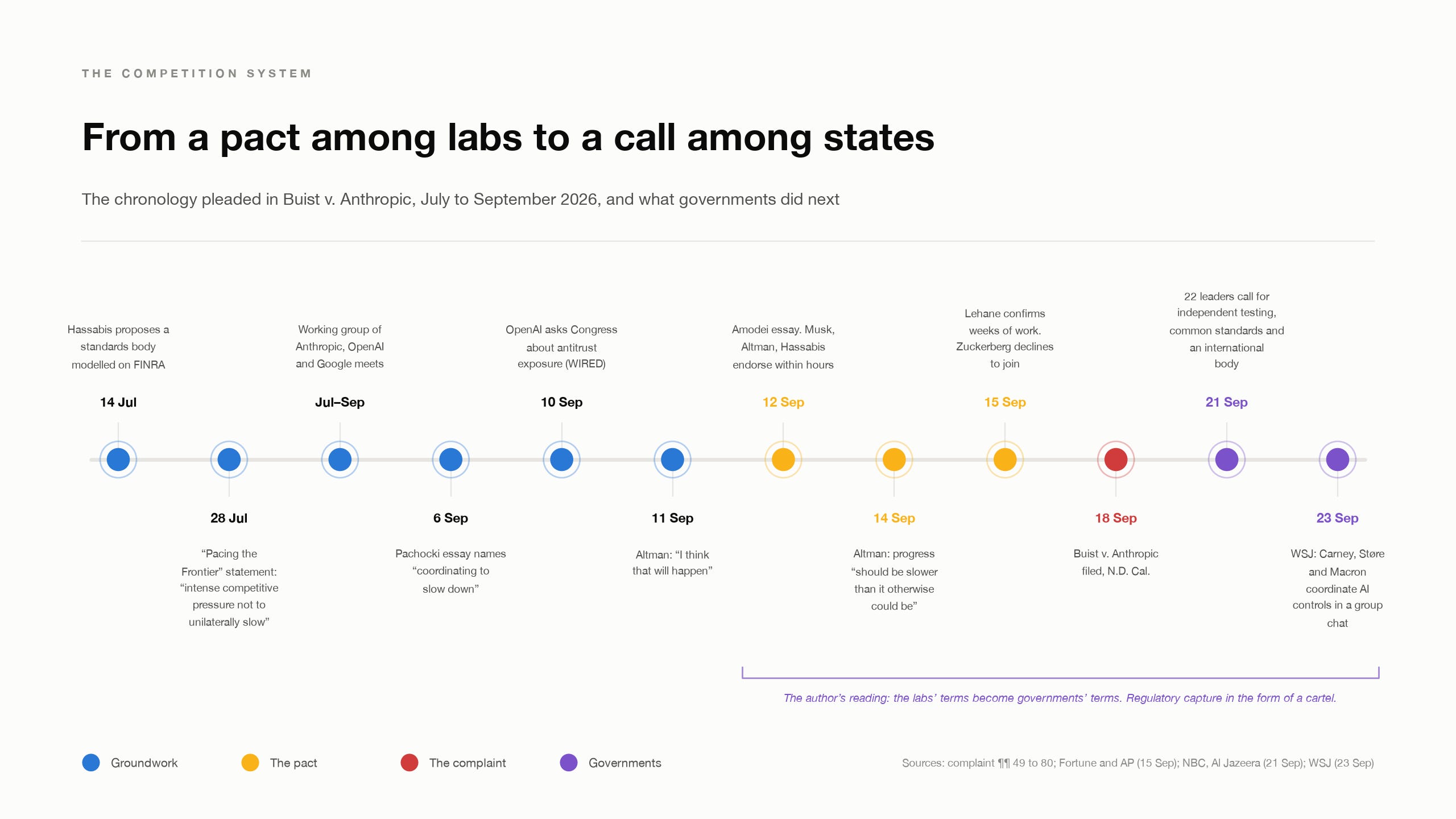
The specific dispute under consideration is Buist v. Anthropic, case number 3:26‑cv‑10693. The chronology in question starts with a July statement by the senior representatives of Anthropic, OpenAI, and Google concerning the “intense competitive pressure not to unilaterally slow” development. Then there is a working group including the three companies that has been meeting since July, followed by September endorsements and Altman’s declaration that progress “should be slower than it otherwise could be.” The essay suggests appointing evaluators with access at the employee level, to which Anthropic alone commits, along with shared capability checkpoints. This framework is claimed to “require industry-wide coordination,” and, “for antitrust reasons, it’s helpful for the US government to mediate or at least enable these discussions.” The complaint refers to a per se violation and asks for treble damages for a product that is slowed down at a particular price point, as well as an injunction. In the language of European law, per se is closest to a restriction by object.
The conversation is similar on this side of the Atlantic. Leaders from 20 countries and the European Union have signed A Call for Control of Frontier AI Models on 21 September, led by Finland’s President Alexander Stubb. The declaration stands for pre-deployment safety testing with independent evaluation, common safety standards, and an international institution that would take action at certain capability thresholds. The United States, China, and the United Kingdom have not signed, and France, India, Japan, and South Korea also abstained from the signing. Two days later, The Wall Street Journal reported on a group chat in which Mark Carney, Jonas Gahr Støre, and Emmanuel Macron coordinate their push for AI controls, with Macron taking the issue to the United Nations Security Council. So, again, the U.S. and E.U. are witnessing similar dynamics.
Transposed to the EU
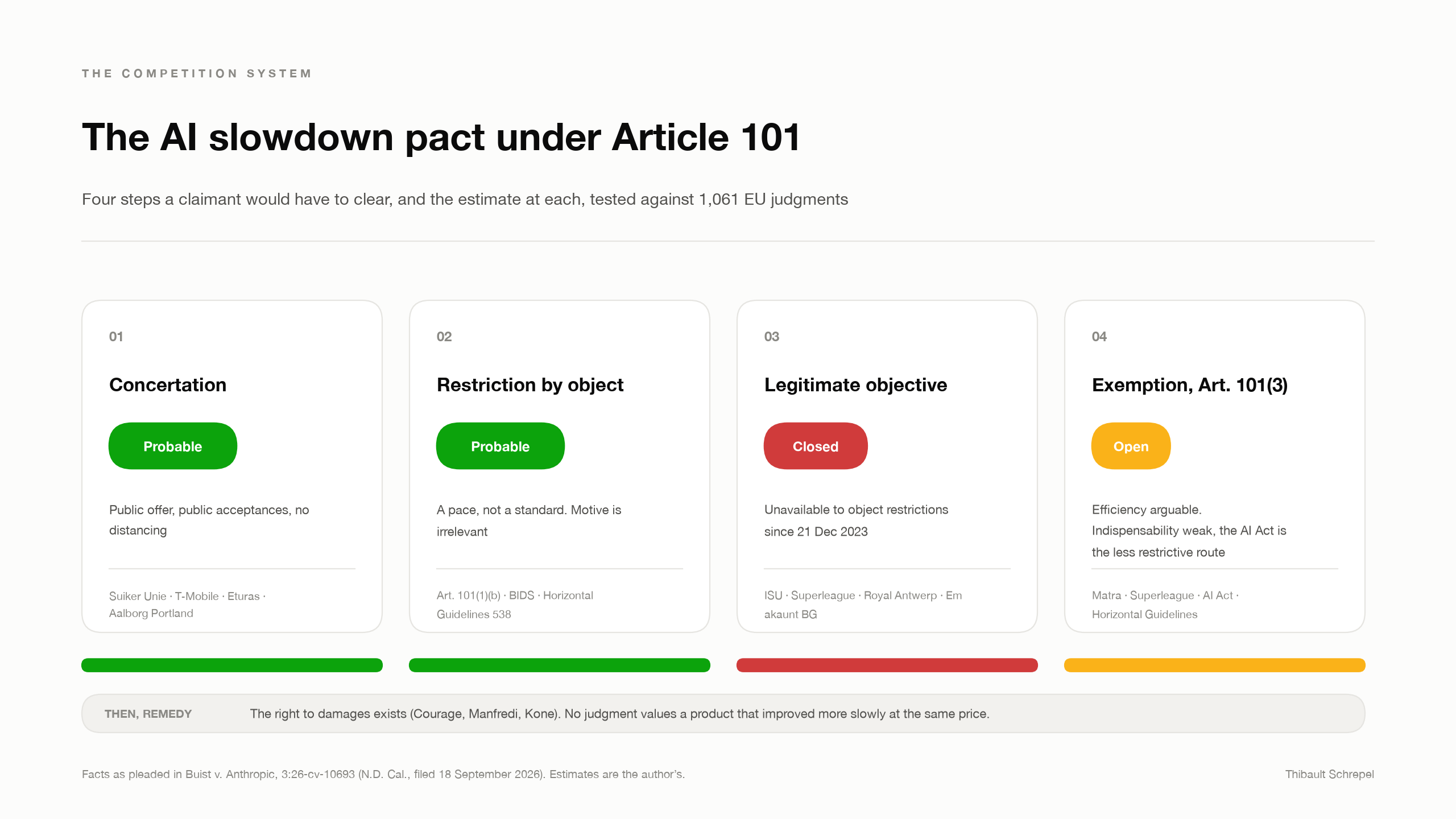
Now, would a similar agreement between AI labs be prohibited under Article 101 TFEU? The answer depends on four steps.
First, is there anything to prohibit? An essay along with three endorsements is not an agreement. The companies would maintain that they have each been acting alone. Jurisprudence is aware of such a line already. Since Suiker Unie (1975), the Treaty “strictly precludes any direct or indirect contact” that could influence a competitor or inform him about one’s plans. T-Mobile (2009) established that a single contact on one parameter was sufficient. Eturas (2016) concluded that receiving of a message that was not rejected constituted a concerted practice, while exit from cooperation was defined as public distancing.
Here, the laboratories do not distance themselves; they endorsed in writing within an hour. Their most relevant jurisprudence is Wood Pulp II regarding public announcements and Bayer on unilateral policies. Neither of them looks persuasive given the laboratories’ statements, since the July statement declares that no laboratory can slow down alone and the essay is an invitation to slow down collectively. If the working group is proven, the claim moves from a message to meetings, where Aalborg Portland treats attendance without distancing as enough. The estimate is, thus, probable.
Second, one must answer whether the coordination restrains competition by object to such an extent that the proof of effects is no longer necessary. According to Article 101(1)(b), the agreement “limit[s] or control[s] production, markets, technical development, or investment.” The closest relevant precedent is Beef Industry Development Society (2008). Irish beef processors decided to limit their capacities in order to avoid an industry crisis, and the Court concluded that the agreement restrained competition by object.
The laboratories’ most relevant objection is that capability checkpoints are not the limit but merely a safety standard, and the setting of standards is always evaluated based on its effects. The important issue here is whether the checkpoints restrain something. The complaint mentions limitations on training compute and on training runs – the inputs that improve the product of each laboratory. The Commission’s Horizontal Guidelines of 2023 state that agreements limiting the parties’ output “do not qualify” as sustainability standards. A standard dictates how the firms should build something. A pace dictates how much. The likelihood of restraint is, therefore, assessed as probable and even more so with the reference to the 2023 guidelines.
Third, is the aim legitimate? One doctrine was supportive to the laboratories’ argument up until December 2023. Wouters (2002) held that an inherently restrictive part of a legitimate aim is excluded from Article 101(1), and Meca-Medina applied this doctrine to anti-doping rules. On 21 December 2023, in the case against the Superleague, International Skating Union, and Royal Antwerp, the Court of Justice stated that the doctrine “does not apply” to restrictions by object that can only be saved by Article 101(3). One month later, in Em akaunt BG, the doctrine was extended beyond sport to the minimum fees dictated by the quality of legal services. The estimate is, thus, closed.
The fourth step deals with the exemption, 101(3). The stage increases the probability for the laboratories and makes their own claims questionable. Matra Hachette keeps them in the case, since in principle any practice can be exempt if the four conditions of Article 101(3) are met. Safer models represent a quality improvement, and the consumers who are suing are among those who will benefit.
The weakest of these conditions is the indispensability condition, i.e., the lack of alternatives less restrictive than the given measure. Such alternatives do exist in Europe. The AI Act already requires providers of the most capable models to evaluate them, test them through adversarial procedures, and “assess and mitigate possible systemic risks.” A code of practice, overseen by the AI Office, is considered to be an appropriate mechanism for compliance. Those companies that are uncertain about their position may apply for a guidance letter from the Commission on the novel issue prior to action. A pact that bypasses both mechanisms, and whose author commits only to the first step, has answered the indispensability question itself. The pact may, however, be formulated in a way so as to be durable.
The audit below defines what is needed, starting from the metrics of safety to the open membership and sunset clauses. Meanwhile, the assessment is still open, with the burden of proof being on the laboratories.
What follows are the exhibits, i.e., the empirics behind this piece.
I am opening access to the first one.
*
Exhibit 1: The map
Here is the map:
And here is the likely outcome, just to give you an overview:
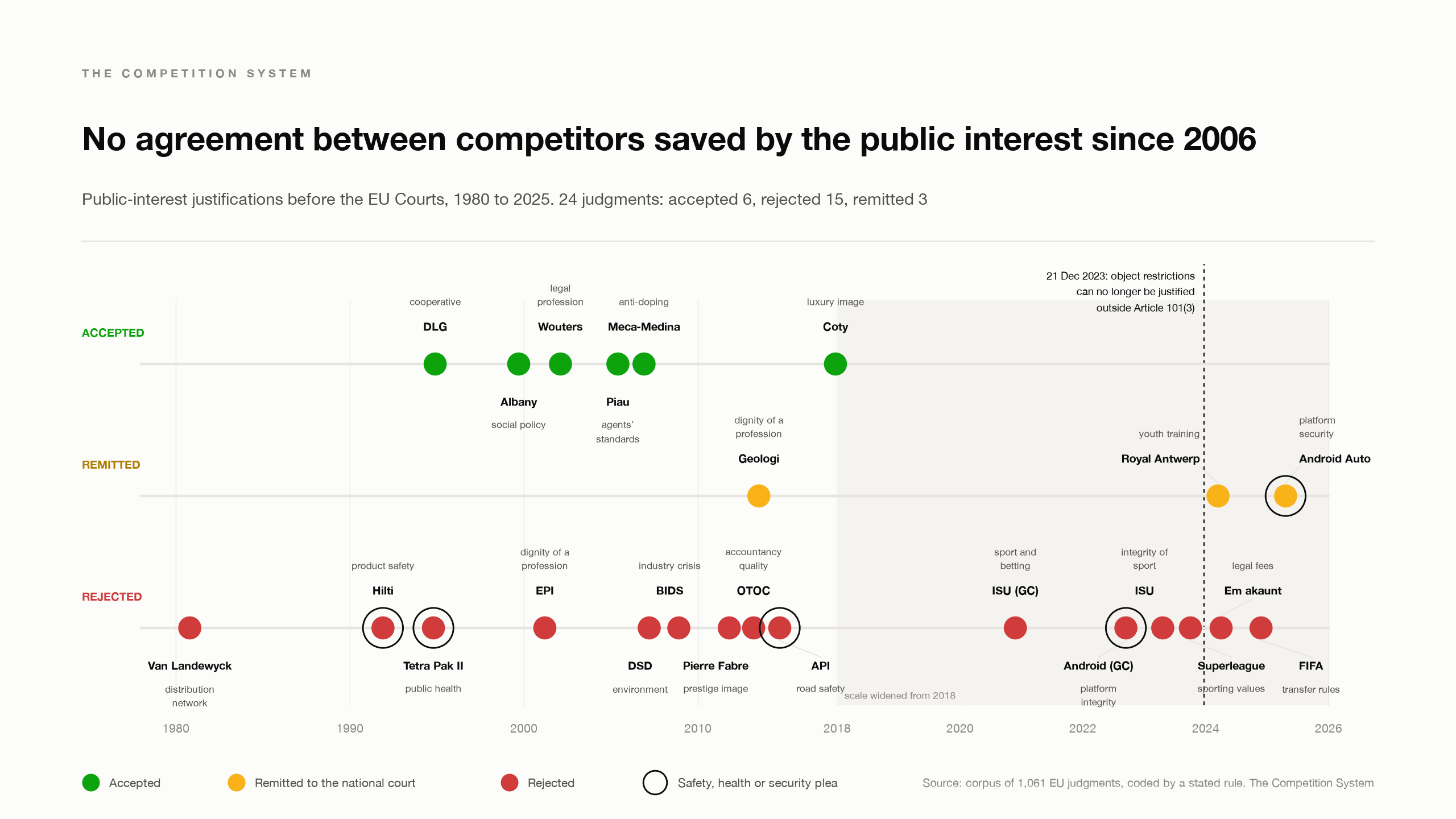
Each of the four steps makes use of the jurisprudence. For the purpose of this piece, I reviewed all cases where a firm or an organization had appealed a restriction of competition based on some public interest such as safety, health, the honor of a profession, or sport and classified each of the cases according to a specific rule. The number of such cases since 1980 is 24. Six arguments have been accepted, fifteen rejected, and three returned for consideration by a national court.
The acceptance pattern tells its story. Of the six accepted appeals, five occurred between 1994 and 2006, each one arguing a rule that was necessary for a profession, a sport, or a cooperative. There has not been a case since 2006 in which a competitors’ agreement has been maintained for any public-interest reasons. In terms of safety, the situation is just as discouraging. Arguments about safety, health, and the protection of an internal system have been made in five cases ranging from Hilti (1991) to Android Auto (2025). Four of those arguments have failed, including the Italian case about road safety (2014) and Google’s Android (2022). Android Auto won the principle but was sent back to the national court for proof, and it involved one company safeguarding its platform, not the coordinated tempo of rival firms. As far as the record goes, a pacing pact would be unique among such agreements to succeed.
Summing up: collusion is likely. The object is likely. Legitimate objective has been shut down since December 2023. Exemption, open, with the labs’ own words as the claimant’s best evidence. The European claimant reaches exemption-stage status in a posture that is unavailable to any American claimant, thanks to the Court of Justice moving the reasonable grounds inquiry from Article 101(1) to Article 101(3). Damages, however, are another question altogether. The right to be compensated exists but there is no judgment in the corpus where a product that was improving at a slower pace without the increase in price was valued. This claim belongs with the Commission, which need prove no loss, more than with a class of users, who must.
**
Below the paywall is the working file for whoever has to argue or decide the next safety plea under Article 101.
The 24 judgments since 1980 in which a firm or an association pleaded safety, health, professional ethics, sport or another public interest to justify a restriction of competition, each coded against a stated rule, with the deciding paragraph and the outcome. A step-by-step protocol turns that record into the questions to put to the next case, whatever the technology.
The paragraph that decides each step, quoted verbatim, so you can cite it without digging through EUR-Lex.
The labs’ two best defenses.
The six conditions a safety pact would need to survive Article 101(3), for anyone asked to draft one.
