

Alexis de Tocqueville distinguished two kinds of centralisation in Democracy in America. Governmental centralisation concentrates the power to direct what is common to the whole nation, such as the making of general laws. Administrative centralisation concentrates the power to direct what belongs to its parts. He found that the United States had a great deal of the first and none of the second, and he could not conceive that a nation might prosper without the first.
The AI Act makes a similar split. When the Commission proposed it in April 2021, it chose a regulation over a directive. Its explanatory memorandum noted that some Member States were considering national rules on AI, which would “likely lead to” “a fragmentation of the internal market on essential elements”, and that “the direct applicability of a Regulation, in accordance with Article 288 TFEU, will reduce legal fragmentation”. The rules were centralised. Their administration was left to the Member States. For a firm selling AI systems across the Union, that choice decides whether it enters one market or twenty-seven.
So I checked what the Member States did. I collected the national measures on AI adopted or formally tabled between 21 April 2021, the day of the Commission’s proposal, and 23 October 2026, and checked each one against an official source. I counted only measures whose operative provisions refer to AI or to the AI Act. I found 62, in 24 Member States. I make no claim that this is all of them. Parliaments publish in 24 languages, and AI provisions hide in amendment bills with generic titles. Every measure is linked to its source in Exhibit 1, and corrections are welcome.
Most of it is the Regulation working
The AI Act does not apply itself. It requires each Member State to designate the authorities that supervise it (Article 70) and to set penalties (Article 99). It also requires a regulatory sandbox (Article 57) and a list of the authorities that protect fundamental rights (Article 77). In a few places it expressly lets Member States legislate, for instance to authorise real-time remote biometric identification by the police (Article 5(5)) or to protect workers more than the Regulation does (Article 2(11)). A national law that does this applies the Regulation. It does not depart from it.
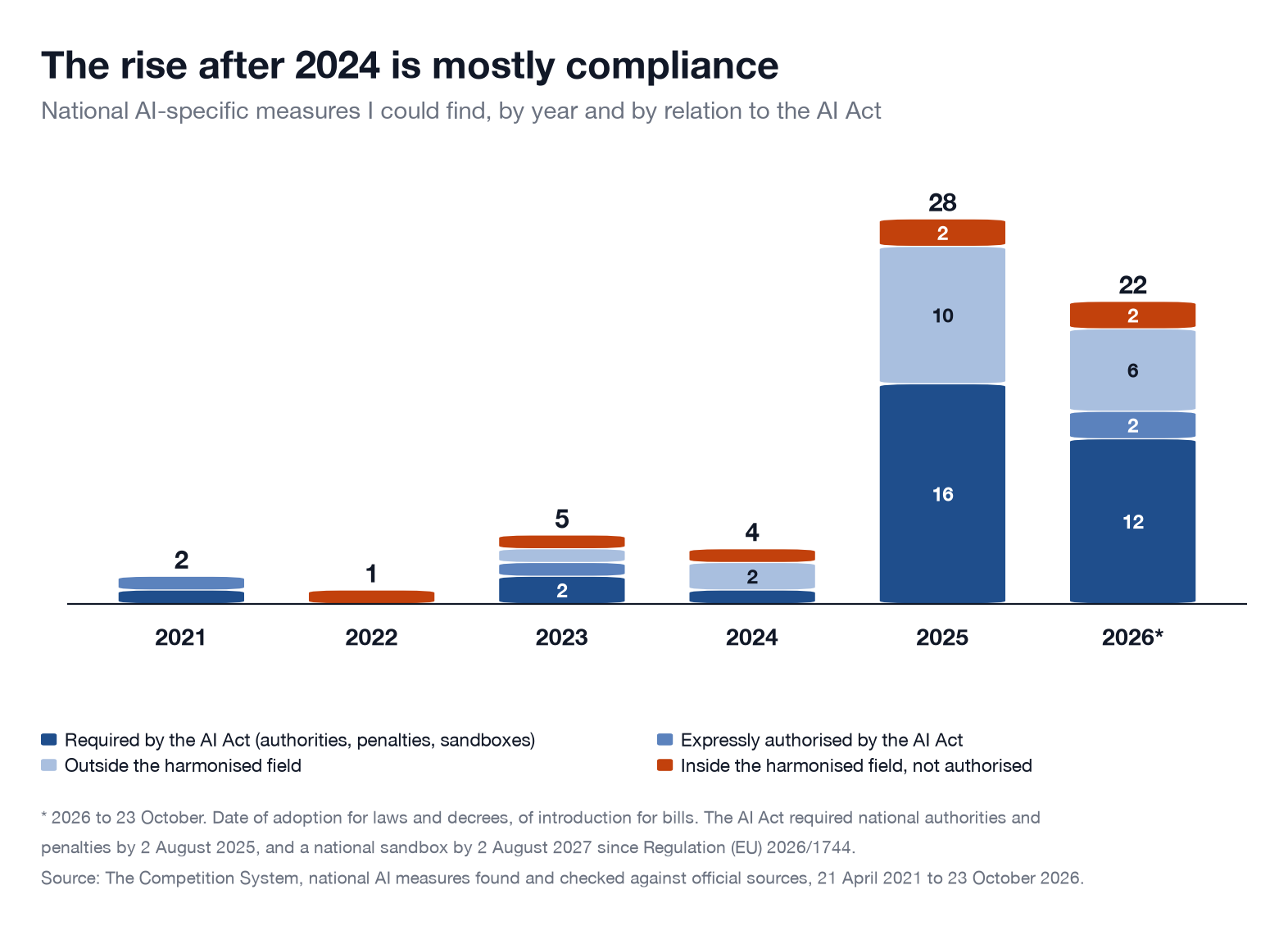
32 of the 62 measures do what the Regulation requires, three of them in Spain, which set up its AI agency and a sandbox before the Regulation was adopted. Four more fall within an express authorisation. Sweden’s law on real-time facial recognition by the police, for example, uses Article 5(5). This changes how the timeline reads. National activity rose from four measures in 2024 to 28 in 2025; 16 of those 28 are instruments the Regulation requires.
The divergence is administrative
The Member States differ in how they administer the common rules, and that is where a firm competing across the Union feels it. Germany’s KI-MIG makes the Bundesnetzagentur the market surveillance authority. Italy splits the role, with the digital agency AgID as notifying authority and the cybersecurity agency ACN for market surveillance (Legislative Decree 179/2026). Finland spreads supervision across sector agencies and attaches a sanctions board to Traficom (Act 1377/2025). Greece gives market surveillance to its data protection authority (Law 5321/2026). Malta adds national fines of up to EUR 350,000 or 1 percent of turnover, “without prejudice” to the penalties of the AI Act (Legal Notice 226/2025).
None of this breaks the single rulebook. It changes what compliance costs in each market, because a firm faces a different authority and a different penalty scale in each Member State. For an AI provider, the question is less which rules apply than which 27 administrations apply them (more details in Exhibit 2).
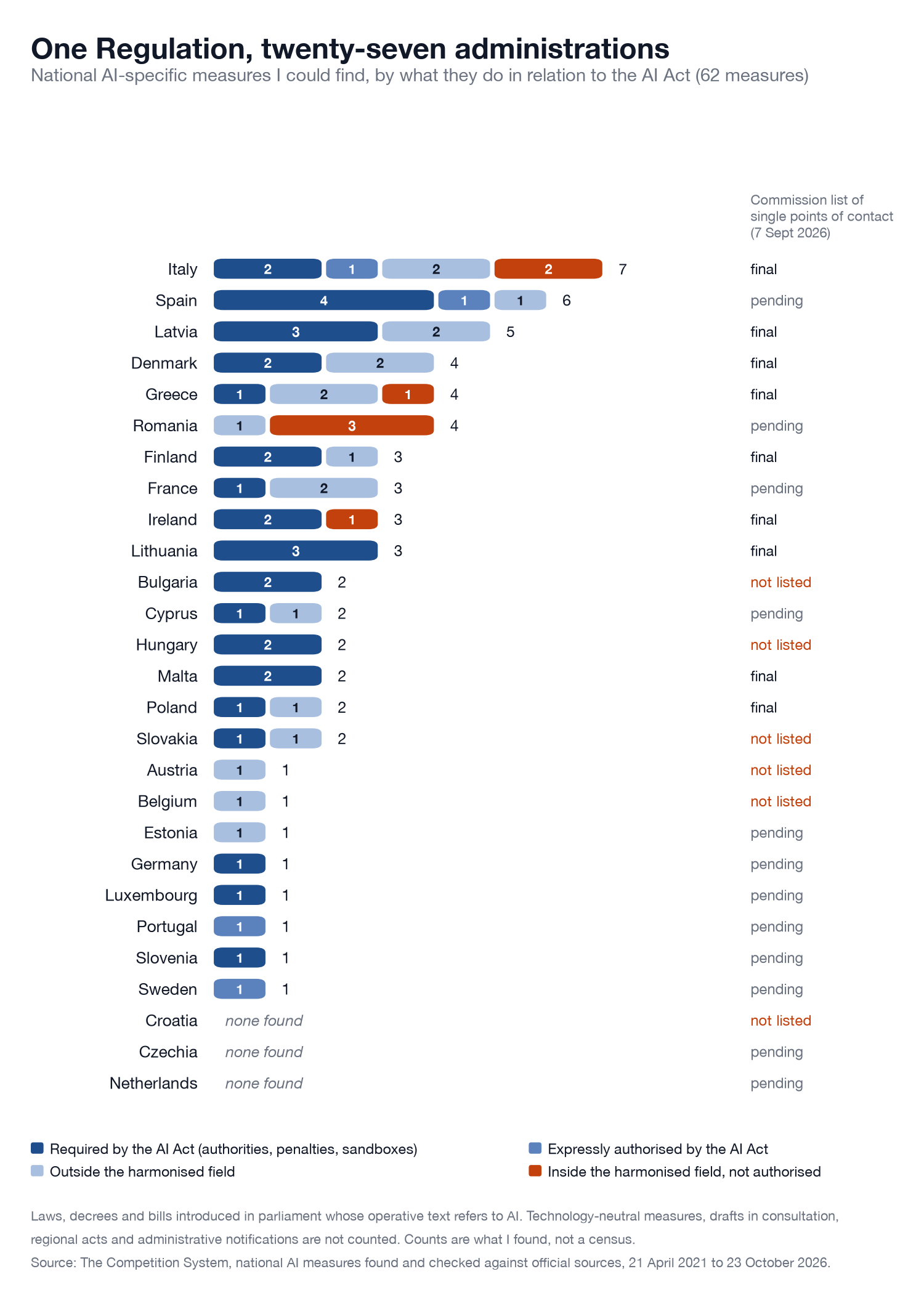
The administrations also move at different speeds. By my count, 15 Member States have adopted at least one instrument of the kind the Regulation requires. That does not mean each of them has completed the designations of Article 70. Bulgaria’s instrument is a government decision on the fundamental-rights authorities of Article 77 (see this official statement). Cyprus’s is an unpublished government decision announced in an official release. In the 12 other Member States I found no such instrument with legal effect by 23 October 2026, although Article 70 set the deadline at 2 August 2025. They are Austria, Belgium, Croatia, Czechia, Estonia, France, Luxembourg, the Netherlands, Portugal, Romania, Slovakia and Sweden. Sweden has named interim authorities by administrative means, and a Romanian government memorandum proposes one. The Commission’s own list of single points of contact, dated 7 September 2026, shows nine Member States as final. It lists Germany as pending although the KI-MIG was already in force, and it does not list Hungary, which adopted its implementing Act LXXV in October 2025.
Sandboxes are where administration turns into competition between Member States. The Regulation first required one per Member State by 2 August 2026, and Regulation (EU) 2026/1744 moved that date to 2 August 2027. Spain opened one by royal decree in 2023, before the Regulation existed. Latvia built one into its AI Centre Act in 2025. Finland tabled its sandbox bill on 22 October 2026. A start-up chooses where to test, and the Member States that legislate early compete for it.
Outside the harmonised field
19 measures use AI-specific rules to pursue objectives the AI Act does not harmonise. Ten deal with AI-generated content or AI training, in criminal, copyright, electoral or advertising law. Most of the others govern how public authorities and schools use AI. One matters directly for competition. Belgium’s federal bill of May 2026 would bar the administration from AI systems whose full source code and technical parameters cannot be consulted publicly, and would require hosting in the European Economic Area under public control. EU procurement law, rather than the AI Act, is the yardstick for that bill.
Deepfakes show how national and EU law interact. A 2024 directive on violence against women already required Member States to criminalise making sexual deepfakes of a person accessible without consent. Bills on deepfakes had also been tabled in Romania in 2023 and in Spain and Slovakia in 2025. The Commission’s November 2025 proposal to amend the AI Act proposed no ban on the systems that produce such images. The Member States, acting in the Council, added a ban on AI systems that generate non-consensual intimate images in their general approach of 13 March 2026. It is now Article 5(1)(ba) of the AI Act through Regulation (EU) 2026/1744, applicable from 2 December 2026. National bills came before the ban, but the record does not show that they caused it.
Where Article 114 is tested
The Regulation’s first recital says it prevents Member States “from imposing restrictions on the development, marketing and use of AI systems, unless explicitly authorised by this Regulation”. Placing each measure by its main effect, I found seven that cross that line or come close to it (more details in Exhibit 3). Some broader measures also contain elements of this kind, Italy’s national AI law of 2025 among them, but their main effect is to implement the Regulation. Whether any of these measures conflicts with the Regulation is a legal question I do not settle here.
Six of the seven are bills tabled by members of parliament rather than by governments, and none is in force. Two Italian bills (A.C. 2580 and A.C. 2927) would add national labelling and watermarking duties for AI content, where Article 50 of the Regulation already sets the transparency rule. Three Romanian bills were sent to the Chamber of Deputies, which decides after the Senate, according to Senate records. The Senate adopted the deepfake bill in 2023 and rejected two general AI bills (L255/2024 and L140/2025). Ireland’s AI Companion Services (Protection of Children) Bill 2026 would prohibit making certain AI companion services available to children. The seventh measure was a chapter of a law, and it no longer exists. Greece adopted national AI rules in a chapter of Law 4961/2022, while the AI Act was being negotiated, and repealed that chapter in 2026 to make national law compatible with the Regulation.
The Union has a filter for drafts of this kind, the notification procedure of Directive (EU) 2015/1535, but it delays rather than blocks, and I found none of the six pending bills in the Commission’s database. Until each bill passes or fails, a firm planning its entry into these markets cannot know which rules it will face. The one AI bill that went through the procedure, and two ways to make the filter work better, are set out in Exhibit 4.
What this says about the single market
The AI Act did not stop national legislation on AI, and it was not meant to. Most of what the Member States did after 2024 is the implementation the Regulation required. Counted by main effect, the measures that test Article 114 are six members’ bills and a repealed chapter of a Greek law. What diverges is administration, in who supervises, at what speed and with what penalties, and that is where the cost of competing across the Union is now set.
Tocqueville could not conceive of a prosperous nation without governmental centralisation, and the AI Act supplies it. Whether a single market for AI follows now depends on the other half, the twenty-seven administrations the Regulation left to the Member States.
The audit
The claims above rest on a dataset of 62 national measures, each checked against an official source. The audit below the paywall sets them out in four exhibits for paid subscribers.
Exhibit 1, the 62 measures. Every measure counted, by Member State and date, with its status, its group in relation to the AI Act and a link to its official text. Italy has the most, seven, and Croatia, Czechia and the Netherlands have none.
Exhibit 2, who enforces the AI Act, Member State by Member State. The Commission’s list of single points of contact set against the national instruments I found, for all 27 Member States, with the operative words of six national designations. Ten of the twenty-one bodies on the Commission’s list are telecoms or network regulators, France’s is its competition and consumer directorate, and in Hungary the market surveillance authority is a minister.
Exhibit 3, the seven measures that test Article 114, provision against provision. The operative text of each national measure, in its language and in English, beside the provision of the AI Act it sits next to, with its procedural status and its next step. One Romanian bill, as tabled, would require a warning covering at least 10 percent of the screen on every deepfake, and one would ban the use of AI to decide court cases, which the AI Act classifies as high-risk rather than banning.
Exhibit 4, what the Union can do about a national AI bill. The notification procedure of Directive (EU) 2015/1535 in its own words, the AI-related notifications I found in the Commission’s database and what the Commission answered, and two ways to close the gap, one in which the Union screens national AI bills earlier and one in which Member States legislate first and the Union decides whether to follow. Denmark notified its deepfake bill three weeks before the Commission proposed to amend the AI Act, and the Commission answered with comments, the mildest response the procedure allows.
